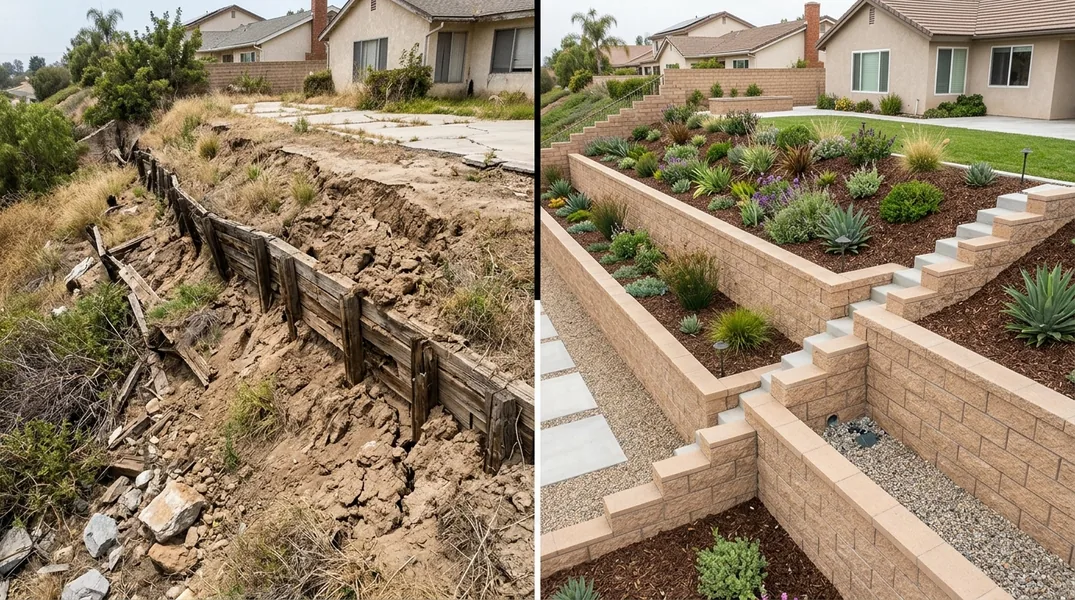
Why Orange County Winter Storms Are Hard on Retaining Walls
Orange County winters may not bring the snow and ice that other parts of the country deal with, but they bring something just as destructive to retaining walls: intense, concentrated rainfall. When a storm system parks over the Santa Ana Mountains and dumps several inches of rain in a short period, the soil behind every retaining wall in Anaheim gets saturated far faster than it can drain. That saturation is where trouble begins.
Most homeowners think of a retaining wall as a solid barrier that holds back dirt. In reality, a retaining wall is a drainage structure first and a barrier second. The soil it holds back is heavy when dry and dramatically heavier when wet. A cubic foot of dry soil might weigh around 100 pounds, but once saturated it can weigh 120 to 130 pounds or more. Multiply that across the entire wall face and you can see why water management, not just block strength, determines whether a wall survives the rainy season.
Anaheim sits in a region where clay-heavy soils are common, and clay does not drain well. Water that percolates into the soil behind a wall can sit there for days or weeks, slowly loading the structure. When the next storm arrives, the wall is already stressed. This is why drainage problems tend to show up suddenly during winter storms even though the underlying issue has been building for months.
Hydrostatic Pressure: The Silent Force That Topples Walls
Hydrostatic pressure is the force exerted by standing water. When water cannot escape from behind a retaining wall, it fills the void spaces in the soil and pushes outward against the wall face. That pressure increases with depth, so the bottom of the wall experiences the greatest force. A wall that was engineered to handle dry soil loads can be pushed well beyond its design limits by water that has nowhere to go.
The warning signs of hydrostatic pressure are easy to miss until damage is advanced. You might notice water seeping through the face of the wall, soil washing out from between blocks, small cracks opening up along the mortar joints, or the wall beginning to lean outward at the top. In severe cases, the wall bulges in the middle or the base kicks out. Once a wall starts moving under hydrostatic pressure, it rarely corrects itself. The movement accelerates with each additional storm, and what started as a cosmetic crack can become a structural failure in a single wet season.
This is why Retaining Wall Repair should never focus only on patching the visible damage. If the underlying drainage problem is not corrected, the repair will fail again during the next storm. A proper repair addresses both the structural damage and the water path behind the wall.
How a Retaining Wall French Drain Prevents Winter Storm Damage
The most reliable way to manage water behind a retaining wall is a retaining wall french drain. This system typically consists of a perforated pipe wrapped in filter fabric and embedded in a bed of washed gravel at the base of the wall, behind the wall face. As groundwater collects in the gravel, it flows into the perforated pipe and is carried away to a safe discharge point, such as a storm drain, a dry well, or a graded slope away from the structure.
A french drain only works if it is installed correctly from the start. The gravel must be clean and properly sized, the filter fabric must be positioned to keep fine soil particles from clogging the pipe, and the pipe must have enough slope to move water by gravity. Many failed walls in Fullerton and surrounding areas were built with no drainage at all, or with a drain that was undersized, improperly sloped, or clogged with sediment within a few years. Weep holes alone are not enough. They help relieve some pressure, but they do not move water away from the wall the way a proper drain does.
If you are planning new construction, Retaining Wall Installation should always include a designed drainage system as part of the scope. If your existing wall is showing drainage problems, a drainage retrofit or full Retaining Wall Replacement may be the most cost-effective long-term solution. You can review typical project pricing before deciding which path makes sense for your property.
Warning Signs Your Wall Needs Help Before the Next Storm
Winter storms in Southern California are often followed by long dry spells, which makes it tempting to ignore small problems. But the damage from a single wet season can compound quickly. Homeowners should inspect their retaining walls after every significant rain event. Look for water pooling at the base of the wall, soil erosion around the wall footings, rust stains or mineral deposits on the wall face, and any sign of movement such as leaning, bulging, or separation between blocks or panels.
Cracks deserve special attention. Hairline cracks in concrete can be normal, but wider cracks, stepped cracks in block walls, or cracks that grow after a storm indicate that the wall is moving. Concrete Retaining Walls are particularly vulnerable to hydrostatic pressure because they have less flexibility than segmental block walls. When a concrete wall cracks under pressure, water can enter the crack and accelerate deterioration. In Orange and nearby neighborhoods, we frequently see concrete walls that looked fine in summer develop serious cracking after a few winter storms.
If you notice any of these signs, it is worth having the wall evaluated before the next rainy season. A small drainage correction now is far less expensive than rebuilding a collapsed wall later. You can request a free estimate to get a professional assessment of your wall and its drainage system.
Retaining Wall Drainage Near Me: When to Call a Professional
Some homeowners can handle basic yard drainage improvements on their own, but retaining wall drainage is not a typical DIY project. The consequences of getting it wrong include wall collapse, damage to adjacent structures, and potential injury. A professional evaluation looks at soil type, wall height, surcharge loads (such as driveways or structures above the wall), and the available discharge points for water. In Placentia and across Anaheim, we regularly find that walls were built without any engineering consideration for drainage, which is why they fail under storm loading.
If your wall is taller than about three feet, if it supports a driveway or structure, or if you have already seen signs of movement, it is time to call a professional. Anaheim Retaining Wall provides drainage evaluations, repairs, and new wall construction throughout the Anaheim area. Our team can inspect your wall, identify the source of water pressure, and recommend a drainage solution that will protect the wall through many winters to come. Call (714) 860-7329 to schedule an inspection or to discuss your project with a local retaining wall specialist.
Looking for a professional retaining wall contractor in Anaheim? Anaheim Retaining Wall responds fast for all your retaining wall needs.
Get a Free QuoteOur services: Retaining Wall Installation · Retaining Wall Repair · Retaining Wall Replacement